Ryan Blacketter is the author of Down in the River (Slant, 2014) and Horses All Over Hell (Wipf & Stock, 2019).


—Ernest Hilbert, author of Last One Out, book critic for Wall Street Journal. Dust jacket blurb.


Consider his poem "The Laughing Heart."
don't let it be clubbed into dank submission.
be on the watch.
there are ways out.
there is a light somewhere.
it may not be much light but
it beats the darkness.
be on the watch.
the gods will offer you chances.
know them.
take them.
you can't beat death but
you can beat death in life, sometimes.
and the more often you learn to do it,
the more light there will be.
your life is your life.
know it while you have it.
you are marvelous
the gods wait to delight
in you.
Masculine or feminine can matter in a certain decade, and sometimes it seems to have overwhelming significance. Take a look at the Best American Short Stories of the 70s sometime. There are names that you know and, mostly, names that you don't. Literary journals from that period are full of alpha super studs imitating Hemingway and failing, because they didn't communicate his emotional power and love of men and women.
Hemingway loved Catherine Barkley, Lady Brett, Pilar, and "the girl" in "Hills Like White Elephants." Some believed his masculine swagger was the whole story. But it was his kind treatment and understanding of all people--along with his revolutionary writing style--that made him a world-wide author.
Many male authors continue to grapple with Hemingway in the wrong ways. In conservative lit mags and small presses, I encounter stories about alpha characters trying hard to smash political correctness in every line. I don't like PC, or PC stories, but I feel that some of these authors are overcorrecting. It's probably best not to react to politics too much.
The creative trance, when finally discovered, is a gentle place, a dream in which human nature reveals itself, and anger and revenge are distant mental ghosts secondary to our deeper urgencies.
New literature often amounts to a smash festival, a war of fictional badasses who are in the game for the kicks and punches. It's possible to write well about enraged men and women, but it ought to be clear that the characters are flawed.
But in life, men and women are going to be angry sometimes. Sometimes there's a good reason. Men and women are ignored for publication or promotion, often due to political reprisals. Whole groups are canceled due to their sex. In the 70s, women were trashed and reduced in some ongoing bad joke. Now men are getting hit in similar ways.
But regarding women currently, you can't have a double Trump administration without a large social response.
Before Trump was elected a second time, I noticed the ice was melting between us all. There were fewer stern faces in my city. It seemed that a return to friendliness was forthcoming. Even literary magazines seemed to be laying off politics and finding their way back to literature.
Then Trump returned. He and his cabinet seem to consider every woman in charge a DEI hire. They have fired as many women from corporate jobs as possible, canceling government hiring initiatives, flicking them out regardless of their achievements. The White House teems with misogynist creeps like Pete Hegseth, who kills female promotion and reads from the Bible to teach us how to follow proper roles.
Trump's strategies seem calculated to generate rage, and that's a very stupid thing to do.
It's not as if female anger is a mystery. Now the reprisals will come, and it's not exactly fair in every case. Many men don't support Trump. But politics today works as a continual carpet bombing, back and forth. Men will punish women, and women will punish men, and on and on.
This war is found everywhere. It's certainly found in most literary journals. A few years ago, men constituted about one-third of the contributions. Now they are practically nonexistent in many lit mags.
It's never fun to feel ignored or hated, but the hatred isn't permanent. Nothing ever is. As far as literature goes, no author's work is going to be remembered because they have a penis or vagina. Both sides can rest easy on that point. It's excellence and love for the world that endure, in most cases, and the best men and women have that in equal measure. --R.B.


High-Risk Fiction: A Writing Workshop
This class encourages fiction that, like all good writing, takes emotional risks. This riskiness sets literature apart from the dishonesty of bad books, TV, and movies. Workshop is not confession, but in the privacy of their writing rooms students might begin to tell personal stories that perhaps they have only told about other people.
"Tell everything on yourself," Raymond Carver urged. Virginia Woolf would have agreed: "If you do not tell the truth about yourself, you cannot tell it about other people."
 We will read published stories as models. Amy Hempel writes of a woman who abandons a close friend dying of cancer, and confronts the aftermath of her choice.
 Hemingway: A Writing Workshop
We will read the short stories of Ernest Hemingway as writers, applying his mastery of craft to our own fiction. Hemingway is still the most influential writer of our time. His literary principles are universal. He was no minimalist, nor a mere innovator of style. Writers around the world claim him as their greatest teacher, including such talents as Albert Camus, Gabriel Garcia Marquez, Frederick Barthelme, and John Updike.


But regarding the rules of craft, we say Generally, but not always.
Near the beginning, after the mother drops off the girls at their grandmother's house in Fingerbone, Idaho, she sails her car off a plateau and into the lake to her death. By this time, we have already witnessed the girls' grandfather die when a train he works on slides into the lake.
Robinson sets up her cataclysms in the beginning for a reason. Much of the book explores Ruth's inward concussions after losing her mother. There are concerns about who is going to care for the girls. And there's not a lot of talking about it, nor a lot of drama, for the most part.
Soon Ruth's aunt Sylvie arrives to take care of her and her sister, and the book remains quiet but enthralling. She's a hobo accustomed to riding the rails, but displays an easy-going grace and affection. At one point, when the house is flooded and Ruth is concerned, Sylvie grabs Ruth and they waltz in the kitchen, water to their waists.


David has lived on the edges of a homosexual milieu in Paris, while conducting an upright heterosexual life. From a car he glimpses many butcher shops, and regards the daily lifestyle of unrestrained sexuality as a brutal reality that he ought to avoid.

But of course he follows Giovanni to his room, and he is never the same. He's repelled--repelled by himself--and he falls in love, and he despises his new lover.
“But it was not the room’s disorder which was frightening; it was the fact that when one began searching for the key to this disorder, one realized that it was not to be found in any of the usual places. For this was not a matter of habit or circumstance or temperament; it was a matter of punishment and grief.”

When Giovanni is convicted of a terrible crime--the reader learns of this in the beginning of the book--David enters a darkness in which he feels that he is forever trapped. There is no longer any escape from his own nature or the young man he loves.
The Good Brother

I read this book every couple of years when it's time to remind myself of what is important in writing a novel--exposition, transition, emotional pitch in dialog, risk taking . . .
The Good Brother is a contemporary masterpiece. The language is metaphorical and precise, always controlled, the words plain but fresh. The pages carry a kind of spiritual power, as the reader responds to a hundred things done as well as they can be done.
Virgil Cawdill suffers inuendo and cajoling of his Kentucky community until, early on in the book, he kills the man who murdered his brother. He sneaks away to Montana where he encounters a mountain area of various country people, individuals he comes to loathe or like.
A few of them are guarded and he learns about their hard-right views incrementally, including some racism that he finds repellent. He meets a woman nearby who disagrees with the worst of the values around, and yet grew up here and calls the place home.
The Good Brother allows the reader to sit with the discomfort of creep characters--sometimes--as many other great books have done. Virgil Cawdill emerges all the more good-hearted in contrast.
On Virginia Woolf
When people discuss Virginia Woolf online, there are always a few strident Americans who object to her suicide, as if that action erases her accomplishments. But suicide is tragic, not immoral, in most cases. Since Woolf endured bipolar disorder without the aid of lithium--and suffered a gathering of voices that terrified her in the end--her last years played out with sympathy.

The most recent silly remark I read online about Virginia Woolf occurred only yesterday. This comment was uttered by a house flipper: "Why should I listen to her about life? She committed suicide."
Many Americans have a lot of moral judgements, but not much questioning of their own choices, in my experience. To spend one's life flipping houses, playing video games, and turning occasional pages of political thrillers, for instance, is considered exemplary or neutral. To rest in an armchair waiting to expire naturally, while holding an alien romance novel or a joystick, is thought a noble way to finish life.
Virginia Woolf did something extraordinary with her life, exhibiting grace and toughness the whole way.
I doubt many house flippers could endure Woolf's difficult life or make their own lives so meaningful. She was a modernist alongside Joyce and Eliot; a brilliant woman who endured post-Victorian foolishness; a sufferer of a ravaging mental illness; a founder of the Bloomsbury Group; a patient who was owned and controlled by doctors; a formidable seer, a true genius; and a conjurer of new and fantastic worlds that will always be read. She also experienced manic episodes that left their shocks in her mind and body each time. And she changed literature.
The literary life isn't fashionable now. Even small pockets of literary readers and writers in America are shrinking up. I fear we are becoming a nation of house flippers. I often hear the advice, Read what you want. It doesn't have to be Dostoevsky, etc., as if we need more encouragement down the mediocre road.
In this shabby moment of wealth building, of wheatgrass milkshakes and thin, longevity soups, we certainly ought to read Virginia Woolf. We ought to study her books, take notes, discover her craft, and read our favorites again. We ought to demand to understand this brilliant writer, getting a little farther on each read, allowing the books to point inward. Soon we'll feel a satisfying change happening inside us. We'll understand some things about ourselves and other people that we had never dared to admit or explore before.

In America, making some money and expiring quietly like a dandelion in the breeze is considered a satisfactory life. But Woolf was really alive in her efforts and battles. That's what matters most, really being alive while we're alive, doing vital and urgent work.
Despite her illness, she brings out the essence of a myriad psychological characters, exploring the lies we tell ourselves to buffer the shocks. She records the weather, parks, and buildings in London with the richness of the moment and the singular perception of each protagonist, and the friends and children and family who are liked or disliked, sometimes for all the wrong reasons. She explores prejudice, class arrogance, envy, greed, and wrong-headedness in sympathetic characters, because she wrote about human beings, who are flawed, and she allows kindness or a selfless gesture in the same people, all of them contradictory and real. She presents the vital passions of some, like Septimus, a soldier of the first world war, who is shell-shocked, intelligent, and doomed, and the flaccid, conventional hopes of others we also care for. And we see how the world looks and feels, with metaphorical exactness, and it's all true and often so moving.
The Killer Inside Me
Jim Thompson's classic 1950s crime novel explores deputy Lou Ford's descent into a psychotic fulfillment of desires. Like many narcissistic killers, Ford has located a personality that is agreeable to others. When he visits the diner, men and women grin in anticipation of his comments. He's a country boy, with the right values, not the brightest porch light on the block, and therefore not a threat. They trust the badge and the man.
Stanley Kubrick observed that this book is "probably the most chilling and believable first-person story of a criminally warped mind I have ever encountered."

Ford has the ability to hide even from himself. He carries on inside this role of good old boy until he's visited by "the sickness," when he must leave the eyes of the town.
Ford has the common narcissistic trait of careful layering of personality. He's able to commit violence one minute, then chuckle with a waitress and friends the next, presenting an easy sociability.
And yet there's no absolute fortress between himself and his deeds. He knows what he does. This awareness gives him a freewill that renders him all the scarier, but also more human in a dark sense. He's no cartoon or zombie killer.
“I'd forgotten about it, and now I forgot it again. There are things that have to be forgotten if you want to go on living.”
Amy Hempel in the 90s
Reasons to Live is Hempel's best book, oblique, difficult in a way, and each of her stories is absolutely about something that matters. And "In the Cemetery Where Al Jolson is Buried" remains her most popular and anthologized story.
That surprises me because it's such a 90s story--the protagonist looking inward after doing something awful. In our current stories, protagonists tend to look inward only when someone else does something awful.
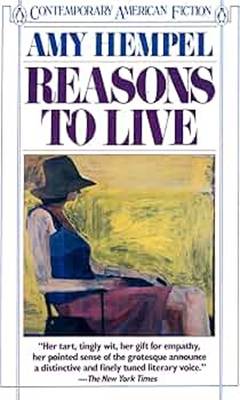
“It is just possible I will say I stayed the night. And who is there that can say that I did not?”
What follows is escape and exhilaration, failure, loss, and regret--and an exploration of her many calamitous fears, as she seeks to understand the depth of her suffering and betrayal.

Amy Hempel was my terrific teacher at the New School in New York City when I went there briefly in the late 90s. She had modeled for Italian Vogue. She talked about Gordon all the time. Gordon feels this way, Gordon doesn't care for that.
The great editor and teacher, Gordon Lish, had to make any genius he encountered his "creature," like he did with Carver, rewriting stories till they were his own. He rewrote Amy's stories as well. She, too, was Gordon's creature. He had creatures all over the place.
I was telling Amy about the slight, social novels we were forced to read in our seminar. "Oh my God, Gordon hates those books. Why are you reading those?"
But this woman who seemed to consult Gordon on every issue was one of the most original writers around. She was friends with Mark Richard, Tom Waits, Francine Prose, and other famous people in NYC, not just Gordon.
What a lovely presence she was in class, her voice shaking now and then, her cheeks blushing. Once, she told us something Tom Waits had said: "When I compose at the piano, these hands are like a pair of old dogs, going to all the places they've been before."
She often dressed in slacks and a blouse, conservative outfits. In the office was a photo of her on the board, with the caption "Got Milk?" tacked there.
I liked seeing her shyness. It was one of the things that made me think that I could keep on writing.
Under the Siren

In my friend Johanna Elattar's non-fiction piece,
"Under the Siren," she presents a moving story about growing up in
Alexandria, Egypt during the war with Israel in the 1970s.
Johanna knew she wasn't to touch toys in the street, for
there might be bombs in them. When the sirens sounded, people rushed into their
homes, turned off the lights, and remained quiet. On this day, it was her third
birthday.
"The candles were lit and everyone leaned close . . .
When I blew the candles out, they raised their hands and mimed applause, palms
meeting the air but never each other. Silent clapping, joy without noise. I
remember looking up at their faces and thinking, You can clap with a smile.
That night I learned it was true."
Instead of an expected nightmare scene during wartime, we see a girl
experiencing love on her birthday. The family moves in dark and silence because
of terrible events outside, but even war can offer kindly moments in shelter.
As a reader, I experienced something like a turn of direction inside of me, and
I wanted to see where she was going next.
A practicing Muslim, Elattar finds kinship with a certain other author, when
she recalls living in the dark rooms and quiet space in Alexandria.

"When I think of that night, I sometimes think of Anne Frank in the annex--writing about a jar of jam, a string of beads, or a chestnut tree glimpsed through a window. She recorded not only fear, but the small joys that made survival human. Her story has always felt close to me, not only because of its universal truth, but because my own mother--Muslim--carried Jewish roots in her family history."
Like all great writers, Elattar obviates the reader's expectations by locating her own truths. She refuses obvious trajectories. She finds commonality while seeing by her own lights. This is what I look for in new writing, but it's hard to find.
Elattar has recent work published at Oxford University Press.
Rain Taxi Interview

The author of the short story collection Horse All Over Hell (Wipf and Stock, 2019) and the novel Down in the River (Wipf and Stock, 2019) talks about his work, inspirations, and characters.
ASO’K: I’d like to ask about Horses All Over Hell, your short story collection released by Wipf and Stock in 2019.
It’s a book of related stories focused upon a family: mother, father, and two sons. You depict problems caused or affected by alcoholism, mental health issues, and religious fundamentalism. These are adult problems, viewed by Cory, a child, who is the elder son. He also does what he can to look after Matt, his younger brother. Why did you choose Cory as the central character?
RB: A child inhabits a compelling psychological world. To a kid, a dog might have the power to read minds. A horse on the side of the road might cast a judgmental glance. Cory’s young enough to live in that magic, but old enough to grasp the troubles of his family. He’s an ideal observer.
ASO’K: The setting of Horses is rural Idaho in the early 1990s. Please forgive the cliché question, but may I ask how much of the setting and characters reflect your real-life experiences?
RB: The town of Laroy is, more or less, Lewiston, Idaho. My family lived there in the 70s and 80s. My dad was an alcoholic, but not the wild drunk that Marty is, and my mom was a very traditional, heterosexual Catholic woman who sat with the dying. My dad was an anxiety-ridden parole officer who didn’t talk much except to yell, though he was good-hearted. I was a sports kid and wore my team uniforms at home, watching TV always. My family was hyper-normal, patriotic and God-fearing without question. Once, I tried on my mom’s bra as a joke, and my brother screamed in fear and tackled me. My mom shouted, “Ryan, this is a Christian household!” My dad was at work. Naturally, I wouldn’t have tried that stunt if he'd been at home.
Later in the 90s, after we moved to Eugene, my brother was a compelling influence. Once he took acid and climbed a tree on campus at night. He called to passersby below and had wild conversations with strangers. One of his favorite books was The Baron in the Trees. He might have seemed like any other hipster, but he had a singular, experimental imagination and jovial intensity, and was a great reader.
ASO’K: Cory’s father, Marty, arrives drunk (or at least uselessly hung over) on the morning when he’s supposed to be coaching Cory’s baseball team practice, then again when he’s supposed to be coaching them for a game. Cory’s mother Joanna has quit drinking and found religion, but sees imposing her religious views on her family as a solution to their problems, and is sycophantically desperate for the approval of the more affluent and socially prestigious members of her church group. What’s the biggest thing preventing Marty and Joanna from fixing what’s wrong with their lives? If they appeared to you and asked for advice, what would you tell them?
RB: I understand your temptation to wonder about this. But I say literature isn’t about solving problems. It’s about presenting problems. After all, we follow character trajectories that make sense, based on psychological realities. I’d feel content leading a character to prison if I understood he had to go there because of the story’s urgencies. I’d feel sad but I wouldn’t try to fix his life or anything like that.
Regarding Joanna, I feel sympathetic toward her. She is troubled by anxiety, depression, and suicidal thoughts. She has quit drinking and needs help. Since she’s speaking from pain and not judgement, I don’t get irritated by her reading the Bible to her kids, the way I might in a more self-righteous context. She’s deeply unhappy in Laroy, but church is the only game in town. She seeks to act like the other mothers because she has suffered a loss of confidence during her depression. She’s my favorite kind of Christian—deeply flawed, on the edge, trying to stay alive. The woman she meets, Lucy, the Native-American, is a similar kind of woman, though farther down the road in her sobriety. Later in the book, Joanna locates strength and toughness, partly due to Lucy’s influence. Where Joanna ends up is far more important than where she is at the start.
ASO’K: Birds seem to be a major motif in Horses All Over Hell. Marty, the father, expresses his dislike of large gatherings of birds. What do the birds represent? Other motifs, it seems to me, are the river and the horses of the title.
RB: My favorite metaphor is one that feels meaningful and right but is somewhat out of grasp. The birds resist explanation because characters speak of them differently. The metaphor changes depending on who’s exerting psychological pressure on it. Therefore, it wouldn’t do to nail it down too much. But I will say that I love the mystery of the image and I think it’s right on the money.
Regarding the horses, I suppose they represent disaster and chaos in the book. Of course, there’s got to be a dash of Revelation in the title too, but I wouldn’t make too much of it.
ASO’K: I’d also like to ask about Down in the River, your novel published by Wipf and Stock in 2014. The protagonist, teenager Lyle Rettew, commits an incredibly drastic act in attempting to come to terms with the recent suicide of his twin sister. If you would consider mentioning it to be a spoiler, we can keep mum about it, or mention it openly if you prefer. Anyway, it’s rather macabre, and truly unconventional. Can you describe how this idea came to you?
RB: When Lyle robs a mausoleum, he is flying on his mania, and therefore believes he’s doing something good. Of course, it is terrible and macabre. Lyle’s action is mitigated, though, when the reader understands he’s acting out of love for his sister, in his own cracked manner. Though his sister’s remains are in Idaho, and he’s in Eugene, Oregon, he associates this body he steals with his lost best friend and twin, Lila.
He meets Rosa, a Latina who says about him, “Oh, you’re not quite right,” but knows he’s a good person at the same time. They happen into some speed. She becomes disturbed when she discovers what he’s carrying around in his backpack, but he explains it again and again—when she’s alternately high and tired—and she stays with him.
Although there’s not much sympathy for bi-polar people in the world right now, especially ones who rob mausoleums, I felt very tender about Lyle. Once, Lyle stands up for a goose who hits the top of a bridge while flying. It sits on the pedestrian walkways below, very dazed. Lyle guards the bridge and forces two kids to turn around, so they won’t frighten the goose.
Rosa says to him, “You’re like some kind of protector.”
But some readers won’t tolerate a sympathetic story about a grave robber. That’s okay. I wasn’t trying to please everyone.
Please check out my free book, The Lord's Hacker, in "Older Posts" at the bottom of this long page.
 Pittsburgh's City Paper "Arts Feature" Interview:
City Paper Interview

Paste Magazine's interview with Ryan Blacketter: "The human story is a fairly dark one with painful and dangerous impulses that we all have. And that's coupled with a fortress-like psychology that most people have, protecting them from the awareness of the fact that they are part of this human experience." https://www.pastemagazine.com/books/drinks-with/drinks-with-author-ryan-blacketter/
Fiction Writers Review: "What makes this novel so warm and heartbreaking despite its gruesome material is that all the characters are driven by their love and concern for each other." Click here to read the entire review:

The Rumpus: "[Down in the River] casts us deep into a haunting, crystalline forest of ice-lit trees, broken streetlamps . . . a place where a kind of inner wilderness has crept back through the city, where the lights of passing trains, the reflections of windows and the 'cry of night birds' appear intermittently like forms of meaningless chaos or secret signs." https://therumpus.net/2014/11/down-in-the-river-by-ryan-blacketter/


"I was completely enthralled by this haunting, page-turning novel. The disturbing events, the evocative landscape, and the chaos of mental disorder self-medicated by drugs and rebellion are all rendered in humanizing, beautifully-rendered realism."
--Wayne Harrison, The Spark and the Drive
"Down in the River is a startling, disturbing, and ultimately entrancing novel, a fever dream that astounds and never sits still for a moment, breathlessly played out in the sad twilight between the innocence of childhood and the despair of age, life lived on the last edges of love and loyalty strained to their limits."
--Ernest Hilbert, author of Caligulan
"Blacketter has created an outsider story of adolescence that left me wanting to travel more with his characters; I felt connected to them as they opened my eyes to new forms of chaos."
--Max Wolf Valerio, author of The Criminal: the invisibility of parallel forces.
—Mary Clearman Blew, author of Jackalope Dreams and Ruby Dreams of Janis Joplin
--Arthur O'Keefe, author of The Spirit Phone
“Lyle is clearly disturbed, but Blacketter never lets him become a caricature, never lets his mental illness cloud his personality or override his humanity. Like Dubus’s characters, even his most terrible deeds are driven by noble impulses and understandable grief.”
"A remarkable, darkly startling and endearing debut novel . . . As Lyle’s quest unfolds with messy inevitability, I am rooting for this young man, I am living as this young man, I am learning to feel as skewed and caring as Lyle does. And what a pleasure this is, and what great inspiration to a fellow writer the experience of Down in the River is. I cannot recommend this novel enough."
"A strange, haunting journey across the shadowy landscape of grief and longing. To our good fortune, Ryan Blacketter is a heroic guide into this exploration of the mysterious workings of the human heart . . . This is a brave first novel from a writer to be watched."


Forgiving Writers--or something like that
Last night I posted about an unlikely alliance between Maya Angelou and Norman Mailer, and the fondness she had for his writing, despite her reservations about the man. "We need to read Norman Mailer aloud," she said.

But the central theme of forgiving writers who have changed the world--Anne Sexton, Raymond Carver, Flannery O'Connor, Cormac McCarthy--seems a manageable subject for an essay.


She said, "Woke 1 was crazy."
We'll need such centrism to vanquish our terrible president and his MAGA associates.
Obama was one of the great center-left presidents. He offered calm, often humorous critiques of the right and the left.
"If I tweet about how you didn't do something right or used the wrong verb," he said, "then I can sit back and feel pretty good about myself because 'Man did you see how woke I was? I called you out!'"

A few leaders seem to be turning back toward Obama. Let's hope that move catches fire nationally.
Complaint Line
YMCA. That was a strange event at the YMCA over the summer, when someone made a "concerning" comment and they shut the whole place down. A spokesperson said nothing was more important than safety.
It was the first time I've ever observed the local YMCA concerned about safety. A year ago, when I went to pick up my kid from camp, nobody knew where he was. Then one of the high school volunteers said he was on the next bus. He wasn't. Then someone said he was across the field. He wasn't. In the main building, a kid who worked the counter said they have way too many kids to keep track of each one. He said maybe my son already took off by himself. I finally found him in the building, looking very lost and unaccounted for.
Other similar, slightly dangerous events occurred at that camp. We have read the news about the YMCA dumping way too many humans into their nice building, at the cost of quality. It's happening at the camp too.
The Good Cow. It's impossible to tip the friendly high school kids at this restaurant. Tips aren't allowed when using cards. One of them told me a shady reason why this is so, but I wasn't able to confirm it. These kids deserve tips! The owner ought to fix it, or pay them extra in their paychecks.
The Kiva. These employees are friendly to people who wear special outfits and have a certain appearance. But many times I have seen them treat others poorly, those who don't measure up in the appearance department. When a construction project was in progress across the street, for instance, I saw them greet the big, dirty workers with faces of disdain or disgust, more than a few times. Treating workers that way isn't liberal. It's creepy.
Maybe the nightmare of MAGA is making everyone mean. But we don't fight MAGA by judging everyone who doesn't look like us. Ask yourselves, What would Obama do? He talked to the janitors in the White House.
Low Pay, Far Away
Teaching ESL is often regarded as a loser's job. Many seem to imagine teachers barking out the alphabet in hot crowded rooms for minimum wage. It's true the positions are often low pay. But my ELS jobs were among my very best.

Thalia always had a reason for withholding the full amount on pay day--already a pittance. She had to buy chicken feed or wood for her porch, something like that. Most payments were one-quarter of what was owed.


Both Hitchens and Flannery have been castigated lately. Americans have a hard time forgiving authors their sins these days. The reason might be that our roots go back to Cotton Mather and the Puritan communities that shamed, banished, or destroyed sinners. All exceptions granted. There were thoughtful and educated Puritans. But even now, many Americans, right and left, love to gather around a sinner and jeer and scream like devils. It's in our blood.

In his speech class, the students are taught to shout “Digression!” whenever a boy, in front of class, strays from the expected pattern.
“But there was this one boy, Richard Kinsella,” he tells Mr. Antolini, whose apartment he goes to when he’s run down and needs help. “He didn’t stick to the point too much…They kept yelling ‘Digression’ at him the whole time he was making it, and this teacher, Mr. Vinson, gave him an F on it because he hadn’t told what kind of animals and vegetables and stuff grew on the farm and all. What he did was, Richard Kinsella, he’d start telling you all about that stuff—then all of a sudden he’d start telling you about this letter his mother got from his uncle, and how his uncle got polio and all…It didn’t have much to do with the farm—I admit it—but it was nice.”
Holden burns to hear anything but the same cookie-cutter ideas that young people hear at school and elsewhere.
What keeps his ample expression of fondness from the sentimental is the many remarks he makes elsewhere that are edgy and sometimes dark.
“People are always ruining things for you.”
“Grand. There’s a word I really hate. It’s a phony. I could puke every time I hear it.”
“Who wants flowers when you’re dead? Nobody.”
Here we see Holden’s whininess—or “negativity”—so unpleasant to Millennials. It must have also shocked conservative young people of the 1950s, who were allowed to speak negatively only about communism and lazy people and so on.
In fact, Holden’s criticism earns all the more trust because it’s deeply personal. Though he’s a child of a corporate lawyer, he never speaks in unison with his class. He has every privilege—and insists on wearing ties and fitting in—but risks his position by his behaviors, and certainly wants to avoid spending his life going up and down in elevators to some fancy job.
From my Essay People Say Hemingway Hated Women--He Absolutely Did Not. Observer, 2017.

All through college I heard that Hemingway hated women. Most
professors dismissed his female characters as male fantasies, insubstantial,
dependent on men, etcetera. But I had a different experience reading Hemingway.
The author I encountered sympathized deeply with all people, women included.
Though I have my own reservations about the macho, photo-op
persona he embraced in middle-age—machine gunning sharks, swilling from a
bottle, grinning next to a conquered marlin or lion—the younger Hemingway, in
his early twenties, had a kid-like vitality and art-loving exuberance that were
enormously appealing.
A rapt listener and watcher, a student of people and books
and Paris museums, Hemingway wanted to write like Cézanne painted. And he was
more tolerant than is commonly known. Despite his conservative upbringing, he
was open to lesbianism—a student of Gertrude Stein and a friend to Sylvia
Beach. He boasted and told lies, sure. But the bragging was harmless. Instead
of explaining the true nature of his leg wound received as a Red Cross
ambulance driver in WW1 Italy, he told of leading crack-shot Arditi troops through
the mountains. Playing Hemingway in Midnight in Paris, Corey Stoll
humorously captures the young writer’s tendency to exaggerate.
But no matter the persona Hemingway embraced at any given
time, the hat came off when he sat down to his typewriter. He had a gift for
capturing people and experience on the page, so that the reader felt it too—a
technique he called “The way it was.”
In his first novel, The Sun Also Rises,
Hemingway brings to life one of his greatest heroines, Lady Brett Ashley. Like
most people, Brett is strong and weak, dependent and independent, according to
the circumstances. Though she’s in love with Jake, he suffered a war wound that
renders him incapable of sex. Therefore she strays. She goes off with men for a
night or a weekend, seeking sex, comfort, or a little money—first with Cohn,
then with Romero. All the while she’s engaged to the bankrupt Mike Campbell,
knowing his family will provide her with an income.
In fact, Brett is a vivid and fully realized creation. Illusive and ambiguous, she wears a man’s hat and crinkles the corners of her eyes when she smiles, often hiding her intentions or trying to. “Brett pulled the felt hat down far over one eye and smiled out from under it.”
She’s also funny. When her friend the Count tells her, “You
got the most class of anybody I ever seen,” she replies, “Nice of you…Mummy
would be pleased. Couldn’t you write it out, and I’ll send it in a letter to
her.”
Brett dazzles men and refuses each one in turn. Neither virtuous or very nice, she’s all the more desirable given her inability to settle down.
Her appeal to Jake is staggering. “Brett was damn
good-looking. She wore a slipover jersey sweater and a tweed skirt, and her
hair was brushed back like a boy’s. She started all that. She was built with
curves like the hull of a racing yacht, and you missed none of it with that
wool jersey.”
After the success of this novel, Hemingway went on to publish A Farewell to Arms. He follows the love affair between Fredrick Henry and Catherine Barkley in the Italian front during WWI. He’s an ambulance driver and she’s a V.A.D. nurse.
On their second date, Frederick, not yet in love, pursues
her as a sexual diversion, and finds her “a little crazy” when she attaches too
quickly.
“I held her close against me and could feel her heart
beating and her lips opened and her head went back against my hand and then she
was crying on my shoulder.
“‘Oh, darling,’ she said. ‘You will be good to me, won’t
you?’
“What the hell, I thought. I stroked her hair and patted
her shoulder. She was crying.
“‘You will, won’t you?’ She looked up at me. ‘Because
we’re going to have a strange life.’”
Then on their third meeting: “‘Say, I’ve come back to
Catherine in the night.’
“‘I’ve come back to Catherine in the night.’
“‘Oh, darling, you have come back, haven’t you?’”
I’ve heard Catherine’s romantic language ridiculed in the
classroom and out of it—unfairly so. The lines are easy to pluck out and recite
with breathy feminine servitude. Her weepiness and desperation, though, have
nothing to do with any “feminine weakness” or “male fantasies.” Catherine lost
her fiancé in the war and has tended to maimed and dying young men as a nurse,
enduring it all alone in a foreign country—an experience that would leave most
people shaken and seeking closeness.
Later, when Frederick returns wounded from the front and in
love, he uses the same language as Catherine. “‘You’ve got to stay. They can’t
send you away. I’m crazy in love with you.’”
And Catherine reveals her mental fissure in clear terms for the first
time.
Catherine says, “‘And you’ll always love me, won’t you?’
“‘Yes.’
‘And the rain won’t make any difference?’
“‘No.’
“‘That’s good. Because I’m afraid of the rain.’
“‘…Why are you afraid of it?’
“‘I don’t know.’
“‘Tell me.’
“‘All right. I’m afraid of the rain because sometimes I
see me dead in it.’”
If Catherine is a little crazy, her disturbances are born
out of a more terrible experience with war than the younger, less experienced
Frederick. Therefore her psychological depth and inner richness surpass
Frederick Henry’s. In A Farewell to Arms, it’s Catherine who is the
quintessential Hemingway hero, the one who carries a great inner wound with
grace.
Hemingway crafted one of his most haunting passages for
Catherine Barkley: “If people bring so much courage to this world the world has
to kill them to break them, so of course it kills them. The world breaks
everyone and afterward many are strong at the broken places. But those that
will not break it kills. It kills the very good and the very gentle and the
very brave impartially. If you are none of these you can be sure it will kill
you too but there will be no specially hurry.”
Many other Hemingway women cut unforgettable shapes: Marita, The Garden of Eden; Pilar, For Whom the Bell Tolls; “the girl,” “Hills Like White Elephants;” Gertrude Stein, A Moveable Feast: The Restored Edition. Hemingway didn’t especially love women—he cared about people. And he respected his best characters by giving them human life on the page, each one a startling individual, as real as anyone we know.

I’m suspicious of the recent impulse many writers have to be incredibly decent human beings. If anything, this mood seems to make people worse, more judgmental, less forgiving, and it’s certainly bad for writing. More and more, in current short stories I read, the protagonist dwells on the behavior of others, and rarely on his own.

Once in the late 90s, a girlfriend told me that she and a friend, in 7th grade, escorted a very hirsute younger boy to the road and took down his pants when cars passed. This wasn’t funny or charmingly “edgy.” She was ashamed of the event. Her mom was a mess and her brother was dangerous, and so she did something awful. She wrote about it in a compelling and honest way.
When my family's Christian community cut us off the vine after my dad confessed that he quit drinking--and thereby revealed that he used to drink--I targeted the nicest boy on my baseball team and punched him in the face. The other boys had followed their parents' orders to shun me after we were cut off, but the boy I punched had still counted me as a friend. But I didn't fear him--he was nice--so he was the one I socked.
In my short story "Convent Boys," two boys encounter a special needs boy who seems to understand that they are poor and unhappy. To pay him back, the boys hit him with a pillow and rough him up a little. While this never happened, I used my experience of punching the nice boy, and the guilt I still have about it, and transferred it to "Convent Boys."
We can get bogged down in too much confession. But when we're not allowed to confess anything due to fear of others' politics or religion, a little confession can be a good thing. It sure beats pretending that we're wonderful and that only others are bad.
The 90s was a more creative time than our own moment. Therefore people were more likely to reveal themselves, in short stories or everyday life.
The ability to admit shameful moments and explore them in fiction shows a healthy awareness that we and others are flawed. Conversely, projecting false positivity, concealing flaws, and blaming others reveal a person who lives as a hidden creature, hidden even from himself, and this person is far more likely to damage others and to produce bad writing.
Exploring a flawed protagonist doesn’t mean the author committed the sin. Rather, there’s a basic stance that the character, and the author, have the ability to do wrong. In stories by Denis Johnson, Amy Hempel, Barry Hannah, Joyce Carol Oats, and Raymond Carver, we see sympathetic characters who are sometimes up to no good. And that is fiction at its best.
Chris Offutt
Offutt was a visiting writer at BSU at one point. The MFA director, Mitch Weiland, told me they went to a bar in Boise one day, and some Marine was talking shit to a woman at a different table, using sexual and demeaning language.
Offutt told the Marine to shut his mouth. When the Marine continued to intimidate the woman and mention her physical assets, Offutt smashed a wine bottle on the table, held onto the bottle neck, and stood up. Then Mitch hustled him out of there before it came to that.
As a student and teacher at the Iowa Writers' Workshop, Offutt was a wild Southerner. He got into fights at bars now and then, but he confronted the ugly, mean, shitty hearts in some people when he encountered them, and I believe he does that in his writing, in part. He didn't look for fights, but he didn't shy from physical confrontations either. Often he stood up for others.
Fistfights were more common then in the Midwest, twenty years ago. Even workshop students resorted to their fists over discussions of books, once or twice, after too many drinks at the Foxhead.
When he was my teacher at Iowa, Offutt had a parole officer. This seemed amazing to me. I was intrigued. I had tangled with cops and judges as a young teenager, and spent nights in juvenile detention, but here Chris was still a wild child in his 40s.
He's married now and has slowed down in his drinking, as they say. He went to Hollywood and wrote for True Blood and Weeds, then published Southern noir and crime novels. He's one of the best writers of our time. The man is even big in France, where he has won four national literary awards. But his books, published in twelve languages, are known around the world.
He seemed to like my work pretty well, though he never said so directly in workshop. Once, I walked home in the snow through downtown, and I heard Chris shout my name behind me. He'd slowed in his Lexus at a cross street. He called, "I think you're a really good writer!"
That was big news for me in those struggling, insecure days. Many Iowa students seemed like patrician hipsters, too ivy-league, too PC, for my taste. My class had four students from Yale, and there was another, from Princeton, whose family vacationed with the Kennedys. Most of my fellow students didn't favor my Idaho stories. But one of my friends, Katie, a Harvard grad with acne and bright red hair, had as much social anxiety as I had, and we were together against the others.
But Offutt's compliment helped me a lot. I didn't tell anyone about it, except my girlfriend. He and I didn't talk much, but we had a rural, working class connection. He saw past the stereotypes of Idaho that were a sticking point for graduates of Old Eli.

They believed you shouldn't write about rural areas, or if you did, you should do it in a disapproving, Mother Jones sort of way. One of them told me that the crazy drunk uncle in my story "They Work at Night" didn't deserve a voice. Another told me that Annie Proulx's Wyoming Stories was a "no no."
Who were these shocking weenies? I didn't know why they were here. Many of these people went on to be lawyers, high-end political fundraisers, or not so literary genre writers.
Beyond the many narrow students, the Iowa Writers' Workshop was an accepting place. Maybe the best evidence of their absolute commitment to writing was their warm inclusion of Chris Offutt, who was a prized author. Director Frank Conroy may have had to fetch him from jail now and then, but he always had a job waiting for him. Offutt was charming and well-liked by men and women. But I doubt a traditional academic department would have endured his Southern traits.
I learned more about writing from Chris Offutt than from any other teacher. His trouble with the law only made him more compelling.

Writers' Jobs
I gave a reading at Barnes & Noble in Eugene three years ago. The women staff I spoke to were relentlessly positive. My books and background were amazing, and everyone we knew in common was amazing. They were amazing, and I was amazing, too. My bio listed my jobs teaching intro. to fiction and comp at Oregon State and advanced fiction at Boise State, etc., but there was no mention of my blue collar jobs.
After the reading, my country friend who'd come with me piped up to a B&N staff member, "Me and Ryan work together at Fred Meyer!"
For the rest of the night, staff traded their amazing faces for frowns, looks of shocked disappointment, or awkwardness. They seemed unable to shake the mental pictures of their nice educated author stocking freezers with Hungry Man dinners or cleaning up spills on aisle seven.
It would be no use telling them that Thom Jones was a high school janitor and Janet Frame tended a cafeteria counter.
My first Barnes and Noble reading was in Boise twelve years ago, when I taught creative writing to seniors at BSU. It seemed that my status as an adjunct professor trumped my accomplishments as a writer. Staff and others asked me more about my job than my writing.
Becca was thirty-six and I was forty-three, older parents, but we had a baby and a book, and it was the best time. Becca had recently been chosen for the Mayor's Art Show in Eugene. There was an article about her painting in the Register-Guard before we left for Boise.

Before those Eugene days and Boise days, when I was in Portland around 2010, most of the creative people I knew worked at pizza joints or cafes. Others were janitors, etc. Portland was changing, due to California development and influence, but there was still a blue-collar ethos to hipster and creative life in Portland.
It was your life, your art, that mattered, not your job. If anything made a person suspect in old Portland, it was sweating for another man's dream while neglecting to have any dreams of his own.
I lived there in the 90s as well--started writing in '95--and I knew writers, musicians, artists, and a young film-maker. Elliot Smith, Katherine Dunn, Bob Pollard, and Chuck Palahniuk were a few of our gods, urging us forward to touch the sun.
By 2019, half of Los Angeles County moved to Portland. Our fine city transformed. Many Californians were already here, but they had Portland values. The newcomers were all business.
Almost no one discussed books and films in bars anymore. It was all about money or jobs. People might discuss some computer system for two hours.
It seemed creative people were suddenly icky types, especially poor ones who worked low jobs so that they could have the mental ease to do their real work.

So, most people I knew quit writing and went to work in tech. It's true they had to pay higher rents, but I sensed the real reason was to remedy the sudden shame they felt about carrying a food stamps card.
But there's often more adventure in blue-collar jobs, or, at least, the people you work with are more raw and interesting. Cormac McCarthy said you should work at places where your characters might work.
I worked on a barge on the Ohio River recently, and was a lead at a cannery in Alaska for three seasons. I carried a hose on a mop-up crew in the Oregon forest. Picked pears in Eastern Oregon two years ago. Worked with old men in the layout department at the Oregonian. At all of these jobs I had good friends. It was always interesting.
I taught ESL in Naxos, Greece, Salamanca, Spain, and Atlanta, and worked in natural food stores in Boston and San Francisco.
Chris Offutt advocated working part-time. That way, young writers could clock the kind of hours needed to produce good writing. Offutt worked more than fifty jobs before age forty. He quit so many jobs because he didn't like people telling him what to do, but working full-time, and lacking time for his projects, was a killing burden for a writer.
My best college teaching jobs were well-paid and enjoyable, but some were unpleasant, low-respect, and practically volunteer. It didn't help when someone said brightly, "You teach college?"
I worked a season in various university basements under Autzen stadium. One supervisor was tall, handsome, mentally sharp, and knew about machines. He told me, "Do you have any idea how fucking stupid it made me feel when you told me you're a writer? It pissed everyone off. Not just me."
It was unusual candor for the blue-collar world or anywhere. He was more impressive in his knowledge and abilities than most writers and academics I knew.
But I know I'm not welcome, with my degrees and books, though I also have a GED. At the start of each job, I always decided never to mention anything that was above basement level, but it leaked out eventually, and caused trouble.
Still, there are stories to be found in basement labyrinths, etc., that you won't find in offices, classrooms, and other such places. That life has inspired the collection of stories I'm writing.
My Literary Friend Turned John Wayne

One of my friends, Adam, was nerdy and subtly effeminate. He had eidetic recall of any book, and his intelligence was interesting and unique. He tutored high math at the university. His favorite musician was Elliot Smith. He got an MFA after taking my creative writing class in Portland.
When he returned, we often met at the 21st Street Bar.
"I found the best way to read the hard parts in Ulysses is to turn the book upside down," he said. "Your brain knows it's seeing things wrong, and so you can see the meanings easier."
He wasn't trying for weird. He had a sense of the way the brain worked--often counterintuitively. But he was hyper normal, at the same time. He was tall, with short hair, glasses, button up shirts, dainty sips of his drinks, punctual, fastidious.
When his dad died and left him his tree nurseries in Wilsonville, he adopted a voice that was a little bit John Wayne. Some of his comments were like movie lines.
"I been chasing my dad's ghost," he said, "but he's chasing me, more like it."
I was haunted when my dad died, too, and I changed a little, moving toward him in his absence.
When Adam and I went out for drinks, though, he was often his old self, kicking around books and anything else. He recited bits of Infinite Jest and Mrs. Dalloway, not like a school boy, but like someone who was interested in people and the world.
He moved between these literary and cowboy identities, until his father's persona emerged at last. Employees at the tree nursery had made fun of Adam for years, and his dad never stood up for him. Now he owned the joint. He liked the power. His new way of talking was part of that.
"Cows are good for any man to see," he said once on the phone, during a whiskey drunk. "Grow 'em up, watch 'em grow."
The tree farms he now owned were surrounded by grazing pasture. He seemed to give himself over to country life. Soon he was moving into one of the homes his family owned.
I understood his transformation to an extent. I had grown up in a country household, where it was all Johnny Cash, Little House, and church. It wasn't a bad way sometimes, when I was a kid, but I was sad to see another writer succumb to middle age.
We liked to quote from Red River.
"I don't like quitters," I said, "especially when they're not good enough to finish what they start."
He put on some weight, and my brilliant oddball friend got lost inside of it, as if sleeping in there. Adam and I talked on the phone for a couple of years until it was clear there wasn't much more to say.
He hadn't done anything wrong except swallow his best self. A lot of people do that.

I discovered Guided by Voices fifteen years ago, while miserably married and fully employed, teaching ESL in Atlanta. In those days, I was earning money for curtains, towels, and bedspreads. Instead of working full-time as a writer slash part-time anything, I woke at 3:30 a.m. to write before work. After my job I went to my counseling appointment—for my attitude and my drinking.
Many evenings I rode my bike to a Mexican restaurant nearby, ate the free chips and salsa at a booth, and drank beer. Headphones and a notebook were good company. A tacky string of fat little bottles hung blinking on the wall above the table I favored. Mostly I took notes on the short stories I was writing, for an excuse to be alone. But I also liked just drinking and listening to Alien Lanes.
My friend Dave, in Portland, had recently mailed me the CD. “Listen and keep listening,” he said in his letter. “It’s all about what we’re trying to do.”
One time at the restaurant, I laughed as I listened to the opening song. I kept laughing, hard, for a minute. Nobody noticed. The staff didn’t visit my table much after my first few days of using the joint as a bar. I’d heard the tune several times. The laughter was probably a weird release of nerves. But also at that moment, I was astonished by the sheer ballsiness of Bob Pollard’s lyrics.
“A Salty Salute” conjured in me a feeling of giddy defiance that I had not felt in a long while: “Disarm the settlers/ The New Drunk Drivers/ Have hoisted the flag/ We are with you in your anger. . .” The singer reaches out to those particularly despised creatures, the angry and not so young, who drink and break the rules and make a mess of other people’s lives. The final lines invite them onto a bus to ride to a lake, where kinship awaits: “The club is open.”
Dave was designing shoes for Nike sixty hours a week in Portland. In his letter he had a cheerful way of saying the job was truly grim. He’d put in his notice and planned to work in a warehouse. And he and his girlfriend were breaking up, for a lot of reasons, it wasn’t only his career change. Dave was ready to get back to work toward writing and directing films—another artist past thirty who did his real work after everyone else was done with him, if there was anything left.
He and I were high school friends who got back in touch after we’d both started writing. In Portland we hit the bars three, four times a week, for a year and a half, until my wife and I moved to New York City and then Atlanta. We burned to make lasting work. Our words came fast with the excitement of our commitment. We were like adolescents who’d happened upon new music at once—an intensity of friendship rare for adults.
Once, we met at the Horse Brass Pub in the late afternoon and closed the place out, after drinking eight or ten good pints. Dave wore his Do the Collapse T-shirt. He’d mentioned Guided by Voices and front man Bob Pollard before. He was going to burn a CD for me, but hadn’t gotten around to it.
It was an hour after closing at the pub. They wanted us out. We kept intending to leave, but continued to talk. We were spelling out lifetime rules: Never quit. Do the real work five hours a day. No full time job. Drink as much as you have to. And don’t listen to people who frown on your drinking. Creative people need to drink, most of them. It’s not romantic, and it’s not part of some clichéd image—for the serious ones. It’s our drug. Let us have it.
Of course, the lovers in our lives were, sensibly, displeased with our friendship right away. We spent time justifying the drinking.
“You should see how much Bob Pollard drinks,” Dave said. “He drinks all day, and nobody has written more songs than he has—not such brilliant songs anyway.”
Finally the barman had to come and tell us to get the hell out. We did.
Since I had no creative friends in Atlanta, it was upsetting to recall, in my isolation, the rules that Dave and I had made two years earlier. Those rules were sacred. They mattered.
“Alien Lanes is goddamned incredible,” I wrote him back.
The album was ecstatically furious, rebellious and moving. In “Game of Pricks,” the singer negotiates hellish employment “with knives at the back of me.” The song pushed beyond anger, to a vulnerable breaking point: “I’ll climb up on the house/ Weep to water the trees.”
The theme surfaced again and again: a desire to pursue inspiring work against the claustrophobic demands of marriage. Predictably, my wife hated the album, given the glorification of drink, but later, at the GBV concerts I went to, in Portland and Iowa City, women and men drank hard and sang along with Bob, or screamed along, pumping their fists.
I listened to Alien Lanes all the time. My wife called me “grumpy headphones.” I was an ass in those days—frustrated, arrogant, and speaking always of my own dreams. But it was the way I wanted to be, and she didn’t know what I went through, & etc.—two lines from the album.
We had a thousand tedious conflicts. I disagreed that four or five domestic beers a night made me drunk. On better days, I knew her ambitions weren’t trivial. Her mother had been a hoarder who watched Christian TV while lying on the couch all day. The girl who grew up in that mess now worked as a medical Spanish interpreter at a hospital. I was proud of her.
But I put on the headphones and escaped into Bob Pollard’s America, where “sad freaks of the nation” embraced low stations, drank a lot of booze, and kicked through walls of opposition, fighting for a life that was compelling and worthwhile.
The album’s sound and feeling were so varied—a melancholia of the trapped, alternating with an ecstasy of the liberated. Heavy guitars followed melodic, ’60s pop tunes.
The theme of following a risky but vital compulsion, despite the loved one’s campaign to defeat you, repeated with a gathering venom. “As We Go Up, We Go Down” was a favorite: “I speak in monotone/ Leave my fucking life alone.”
Balancing out the agreeable self-promotion were moments of humorous culpability and shame, as in “Chicken Blows”: “And I see what you mean/ I’m not here to drink all the beer/ In the fridge/ In the room/ In the house/ In the place/ That we both/ So love.” An ironic note for sure, but the songwriter was unafraid to make his champion beer guzzling look foolish.
Bob Pollard was my kind of counselor. I recognized my own rebellion in these songs, a rebellion I had put aside for my marriage, believing it was the mature thing to do.
By the fiftieth listen-to of “Motor Away,” another raucous tune that kicks ass at every level, I was ready to drive the icy streets to a finer moment: “When you motor away beyond the once-red lips . . . You can belittle every little voice that told you so . . . Oh, why don’t you just DRIII-VE AWAAAAY? Speed on!”
The songs were rattling, disturbing, life changing. “I want to start a new life/ With my valuable hunting knife.” I wanted to run away from everything that wasn’t mine anymore. I wanted to be guided by my own voices again.
I finally did motor away, from a woman who was better than I knew. In Portland, Dave and I moved into a cheap two-bedroom with motel curtains. We worked part-time jobs and devoted everything else to our real work. The place was hazy with cigarette smoke and it smelled of pizza boxes. Cases of tallboys filled the fridge. Keyboards clicked.
We wrote five or six hours in the morning, and at night sometimes too, taking a break from the Horse Brass Pub. While writing and drinking in the evening, it was a blast to loop the rapturous “My Son Cool.” “Decide now! . . . I finally know how, I finally can’t quit/ And ancient ideas are on fire, my love.”
Pollard’s voice was often in the background—or, I should say, the foreground. The man was our exemplar. Dave and I debated his lyrics. We read the bandography Hunting Accidents. We played the documentary Watch Me Jumpstart a hundred times.
Alien Lanes kicks out its twentieth anniversary this year. It continues to glow in the mind like a fantastic planet. When I listen to the album, I often feel it too much. I get shaky and I want to smoke and drive fast, alone.
Guided by Voices fans speak in superlatives. For me, Bob Pollard became a messiah of the creative life, urging me forward for many years to come, in my new, somewhat shabby but inspired career.
Please see the original publication for video content.
https://therumpus.net/2015/09/17/albums-of-our-lives-guided-by-voicess-alien-lanes/
On Remodeling the Writing Factory. Log Cabin Literary, 2006.
When I started writing twenty-five years ago, I had the discipline of a German factory foreman. Every morning at six, I leapt into my work boots and began slapping keys, writing in furious labor seven, eight, ten hours, breaking only to smoke, gulp coffee, and brood. I shouted at sentences, as if the words were lazy employees. Of course, the more I abused the words on the page, the more they refused to function, and the door to creativity was often locked.

Now and then, as if against my will, I slipped into the gentle trance of art.
I altered my work habits. The new, calmer method was more promising, and it was certainly more fun.
Now when I sat down to work, I didn't touch the keys for thirty minutes or so. I sipped coffee and looked out the window--waiting, listening, sitting still. The factory knew I had come to work, and it would wake to its task in due time. There was no hurry, no clock to punch anymore. The tools were silence, calm, patience. I trusted the unconscious to do its slow work.
Soon the factory lights flickered on, the conveyor belts rattled to motion. I glimpsed pieces of my deepest self riding the belts, memories, hallucinations: a sun-faded beach ball, a package of cellophane-wrapped hamburger, a snapshot of my father barbecuing.
When I was in that deeper place, I began to write. Soon recognizable shapes appeared on the page. The gray, still world began to turn, colors emerged. Hazy characters from my past and from my dreams, unconvincing in sketch form, stood and walked, moving and talking like people.
I'd like to say my writing comes faster now, that this slowness has accelerated my production. But that would be more bottom-line nonsense. What's needed is better work, enjoyable work, not faster production.
In literature, better means truer. And it's very hard to transfer emotional and psychological realities to the page. We'll fail most of the time, and knowing about this failure is good: Experiencing the pain of close but not quite, after so much effort, implies that we have a standard, and that our work will improve.
Henry James wrote a careful first draft simply in order to glimpse the germ of his novel's direction and possibilities. The real world moves too fast to see it clearly, and meaningfully, at first glance. Since the most perceptive of us humans are half-blind, groping creatures, we simply can't conjure a true world on the page now. A page a day! A book a year! Ten easy plots!
I left assembly-line writing behind me, and slowed down. Only the dreamy way will get me there, eventually. Writers need a lot of time to decide the simplest of things. Is this bright beach ball of my childhood a sweet, nostalgic thing? Is it an object of menace?
Don Quixote is my lead-man at the factory. Together we run a perfectly useless operation that produces an occasional object of beauty that we couldn't ever sell, and I rejoice. We're not creating romance novels or thrillers. We work for free over here.
I still go to the factory and work hard every day. Good writing needs form and shape, hard work, discipline. But I've remodeled the factory. There are smashed holes in the walls to let in the air, light, and birds. There are indoor gardens and a mysteriously pure stream. The machines are fixed to work at a slow, comfortable speed; they are fixed to quit often and, finally, to lie still, scattered with cowboy boots, whiskey bottles, old socks.
I'm a neglectful, diligent foreman, and it's a good job. The only rule is that I have to sit in the chair during operating hours, and yet I get to stare into space whenever I feel like it. Stretch my legs out, dream, and enjoy the work.

"THEY WORK AT NIGHT," published in Antioch Review in 2011, and in Horses All Over Hell in 2019.
Cory and his mom and little brother went to church every night, and once after Friday mass, they met Lucy at the hotel café. Lucy attended his mom’s A.A. meetings. She wore a long brown coat with a fur collar, in summer, and her hair was short, and she liked to wear aviator sunglasses pushed back on her head. She and her son had moved from the reservation a few years before. The booth window showed Cory how they looked to families driving by—two boys and two women in a diner at ten o’clock at night.
The ceiling vent rattled and cold air sprayed his shoulders.
“Why did Uncle Jerud sleep under the kitchen table last night?” Matt said.
Their mom held her cup for warmth, breathing steam. She told Lucy that her brother in law got a job selling insurance, and that he and Marty dressed up like cowboys and spied on their clients at the bars. “He’s not even trying to come up with good lies anymore,” she said.
“But they’re not lying,” Cory said. “They really are working undercover.”
Lucy stood and tossed a dollar on the table. “I have to pick up my boy at the movies. Stop by my place sometime.”
“They’re not lying,” Cory said.
His mom watched her cross the floor and slouch to her truck at the curb right outside. They smiled at each other, waving, as she drove away.
“Mom, she’s a janitor,” Cory said.
“Yes. Some places need cleaning up.”
“I want to go to sleep.” He glanced at where the sky would be. Long tubes of light reflected in the glass. “We have practice in the morning.”
They clicked shut the seat belts, and she tapped the breaks before their driveway. The porch bulb fanned a bright light on the front door. The two big windows presented black rooms. Cory disliked the outside light flaring while the inside lights were off.
Inside, she helped Matt get ready in the bathroom before tucking him in. Later the house began to creak. Cory knew that Matt didn’t like the creaking.
He trotted into Cory’s bedroom. “There’s a devil in my window,” he whispered. Cory flapped the sheet back and his brother dove in facing away and pulled his knees to his chest, folding up small against the bad things. Cory fit his arm around him, careful not to bother his sleep breaths. He was nice to hold onto when the house was quiet, dark.
A breeze rustled his curtains of gun-shooting cowboys. A chain clinked on the pole out back.

At breakfast his mom accidentally set a plate at his father’s empty chair. She clattered the plate back into the cupboard, put a kettle on, and sat with the boys. She read a magazine, eating bacon. She’d have tea, then rest till late afternoon, reading, napping.
Cory squinted into the back window sunrise.
“Here they come,” he said. “Mom.”
She rolled up the magazine and squeezed it in a fist. Across the back fields, their shapes walked toward home—his father and his uncle, melting against the sun.
They stumbled through the kitchen door laughing so hard they were quiet. His father fell against the stove, knocking the kettle, and rested his elbow on the hot red coil. His shirt sent up a trail of smoke. He dipped his arm into a tub of dishwater. “You guys booby trap the place? Ouch. Damn.” He dropped to a squat. “Ha ha!”
Jerud lay on the floor, laughing. “Booby trap! You kill me!”
When their laughter died, they sighed and hooted, giggled in fits. Jerud had moved here two weeks before. At dinner one night he said he was a tank, made of the same stuff, and what he drank in the bars was fuel for the next day.
“How many days in a row can you keep this up?” she said, when their giggling had settled. His father touched his elbow where he’d burned it.
“Ask my boss here,” he said. “Not easy doing two jobs.”
“Did you catch anybody?” Matt said.
“Caught one,” Jerud said. “Fella claimed a neck injury. We got video of him riding the bull down at the bar.”
“Where’s your video camera?” she said.
Jerud sniffed. “In the car, downtown.”
“Dad, we have practice,” Cory said.
“I know it, buddy. I’ll be there.”
His father lit a cigarette and tipped over and slept. Smoke drifted out of his mouth. The church men had asked him to coach the team. They told him they all took turns.
When the cigarette rolled off his finger, Jerud picked it up.
“Mind if I sleep over?” Jerud said.
“I don’t crash into your house half wild.”
He tapped an ash into his own crew cut. “Well, if you did, I wouldn’t kick you out.”
“Your brother is passed out in front of his children,” she said.
“Aw, you don’t get my sense of humor. Marty’s the only one who gets me.”
“Why don’t you stay at your apartment?”
“It’s empty, it’s lonesome. I’m not too sure about this town anyway. I’m thinking about a move to Vegas.”
“You’re going to quit another job?”
“I hear you been running with that Indian gal,” he said.
“She’s my friend.”
“Yeah, I been hearing.”
She turned off the stove and swung her purse from the chair, went out the back door and threw the magazine flapping over the yard. “Boys, come here!” she said. Matt and Cory followed her out the side gate.
They circled neighborhoods in her car, once around the church, twice around the graveyard. Cory sat in back. In the front seat Matt pounded the plastic farmer against the dash and the head snapped off. He stuck the body in the glove box. Her fingers shook when she floated a hand to change gears.
“Can we say a prayer?” Matt said. He was trying to sound holy for her.
“We’ll go to mass tonight.”
“Mom,” Cory said, “where are we going?”
“Your dad promised me in college, he said no more whiskey—ever. Jerud knows Marty can’t handle liquor. I shouldn’t speak, but you boys know what’s going on. Kids know. I remember. Kids know what’s wrong.”
“I have practice,” Cory said.
“Mr. Larkin might have to coach again.”
“Dad said he’s going to.”
“Honey, did you see your dad just now?” She found him in the rearview. “Did you see him? Did you?”
“Nothing’s a matter. He said he would. He can sleep for two hours and then we’ll go. Practice isn’t till nine.”
“We’ll visit Lucy. She won’t mind.”
She turned onto the river road. Far down in the canyon, house shadows striped the water, and the shimmering parts were like scales. They glided past their house, where his father was sick inside—his mom didn’t even look at it—and she turned onto a dirt road before the high cliffs, the road looping up and into the Orchards. The ground flattened. Rows of trees flashed by in angles. Then came desert country, and they entered a canyon dark in shade, with green fields at its bottom.
Next to the trailer were fenced horses, two staring at the ground while another stared at the visitors. When they got out, Matt offered grass to the horses, but they didn’t want any. A creek slipped behind the trailer. On the shore, next to a tree painted six feet in red, a refrigerator lay on its back.
Canyon walls crowded the sky. Cory tipped his head to see the line of sun.
Lucy came outside in her long brown coat. She wore slippers that weren’t pink anymore. Her hair was messy. Cory scowled around at broken things in the dirt, a tipped over barbecue, a rusted bike. His mom was looking at the figures painted on the trailer. “I love your house,” she said. Then, “My God, are you okay?”
Lucy smiled. “It’s pretty mild as far as black eyes go.”
“Do you ever get any sun around here?” Cory said.
“Not much. But you appreciate it when it comes.”
“I think I’d like having shade,” his mom said.
“Why’s the fridge outside?” he said.
Lucy laughed. “I had to sleep in it last night.”
“Why?”
“What are you, a little cop?” his mom said. “She doesn’t have to tell you anything.”
“I’ll tell him if he wants to know,” Lucy said. “You mind?”
“No, I don’t mind.”
“Well, my husband came to visit my son. He was sober and I let him stay on the couch. But he’s got a mouth on him.” She pointed at her eye. “He gave me this, but I hit him first. Not good, not good. First sober punch I ever threw. Anyway, I wasn’t going to sleep in the house, not with him in it, so I went out back to the broken fridge and chopped out the freezer shelf and dragged the fridge next to the creek. I got in, in my sleeping bag, and shut the fridge door. Kept the freezer door open and listened to the creek. All told, it wasn’t a bad night.”
Lucy opened her front door, laughing. She laughed at anything.
“Look at you all, hugging your elbows. Yes, this canyon keeps cold. Come on in. Jason’s out fishing with his dad.”
Inside, the house smelled like wet ground. Against the far wall a couch sat with no legs, and below the front window, where a TV should’ve been, a green-bulbed lamp without a shade rested on the floor. The woodstove leaked smoke halfway up the pipe, thin clouds drifting near the ceiling. There was nothing on the walls but a couple of paintings. One showed an animal skull next to a fence. He could barely see. In the dim light, the paintings became windows that looked out to desert. Down the hallway a dryer scraped, wheezing.
“Can we stay a while?” His mom’s voice trembled. “Marty and Jerud just got home.”
“You look wore out.” Lucy gave her a hug, sliding a hand on her back. As the dryer buzzed, Cory waved a hand through a smoke stream slanting down the air.
“Mom,” he said. “We have practice.”
“We’ll make it,” Lucy said. “I’m meeting Jason at the field. Why don’t you rest a while first?” She led them down the hall to her bedroom. “Let me throw a cover on this bed real quick. Okay, lay down. Don’t feel funny. There’s room for the three of you.”
They lay down and she came back with an armload of clothes and let the warm things tumble on top of them. “These are extra hot. I was redrying them to have warm things to wear. It’s all a bunch of sweatshirts and T’s. Don’t talk, be still. I’ll wake you up soon.” Lucy floated a blanket down, trapping the warmth of the clothes. Over the window the shade was pulled down. It was like night. “Mmm,” his mom said.
After a while, when Matt and his mom were asleep or lying there, he rolled off the bed and ran out to the living room. Lucy caught him by the arm.
“You have troubles I know all about,” she said. “Your dad’s a drinker, right?”
“No.”
He walked up the gravel drive and down the canyon road, stretching his fingers and making fists. In a field a horse jerked its head up and gazed with laughter in its eyes.
“Why don’t you look away,” Cory shouted at it.
Somebody whistled behind him. It was Lucy, standing in the road, a hand on her head. “Come on back!” When he thought she must’ve heard him yell at the horse, he ran away on weird legs.
The road left the canyon. He found a trail that cut through the fields, toward his house a couple of miles away.

His father walked to the diamond shouldering bats and hauling a ball bucket. He crashed the bats in the dirt. In jeans and no shirt he knelt on one knee, to plan the day, Cory guessed. His elbow was red, with a skin bubble on it, where he’d burned himself. He grunted to his feet and stumbled back one step. He laid a hand over his mouth. At home Cory had found him sitting on the couch with a plate of uneaten breakfast in his lap while Jerud laughed at a cartoon. Cory led him out of the house and opened the door of his truck.
Steam rose off the grass now. A dog chased a butterfly across the field.
“Think I have to sit down,” his father said.
“Already?” Jason said. “Aren’t you going to hit balls to us?”
“You boys run laps a while.”
The boys glanced at each other. A couple of them stepped back, away from his father. They ran laps while he sat cross-legged holding his face.
Across the field, Lucy sat on her coat reading a book, in a T-shirt that pinched her armpits, the mirrored sunglasses over her eyes. Cory’s mom and brother must still have been resting in her bed.
Jason ignored his mom when they jogged past her. After the second lap they stopped in the shade and paced, out of earshot of any adults, hands on their hips, catching their breaths. Teddy Larkin, who was big-jawed like his dad, said, “Worse coach ever.”
“He works two jobs,” Cory said. “All day at the prison, and then at night he’s a detective.”
“He’s a drunk,” Jason said.
“Look,” Teddy said. “He’s trying to stand up.”
“He’s rising from the deep.”
“Will he do it, ladies and gentlemen? Will he stand up?”
Jason applauded. “He’s done it again. He got up.”
The boys clapped, all but Cory. At the backstop, his father stood with a bat on his shoulder. They found their mitts and kicked up dirt heading to center.
His father swung and missed in the haze. He knelt, stood, and he swung and swung, staggering around. More dust rose into the air. Hit it, hit it, and Cory finally heard the crack. They all shoved together, gloves high. Jason fired the ball back and punched his glove like he wanted another. They spread out. Cory quickly tugged the front of his shirt. Then when his father cracked a bad grounder a boy chased the ball into the street. A car slowed fast, bouncing to a stop with a shriek of tires.
“This is dumb,” Jason said. “Why’s he even coaching? We have a game next week.”
When he finally popped another one, nobody ran for it. Sun rays filled the curtain of dust, and his father swayed with a hand against the glare, as if he had lost them.
Lucy jogged over to him. They talked for a minute before she touched his shoulder and he sat in the shade. Lucy took over, hitting mostly grounders, and swinging and missing some. Cory was glad she wasn’t much better.
Although his father was ready for a night off, he went out that night and the next and every weeknight, too, and Cory and his brother and mom went to church.
On Friday night, instead of going to mass, they met Lucy at the fair. His mom and Lucy and Matt walked together while he kept far behind. They were like girlfriends in a movie, clutching each other’s arm, pointing, one of them running ahead. Matt held Lucy’s hand. She flipped a coin into a jar and won their mom a fat stuffed horse. The three of them rode the Tilt-a-Whirl. Flashing bulbs showed their laughing faces. After the ride Cory’s mom wanted him to stay close to them, but he kept running off, losing himself in all the people.
In the morning, the boys were tossing a ball in the backyard when Jerud stepped out the kitchen door. Her music shook the windows, a rock song called Jesus Take Me Home. Clouds slid across the sky and the day flickered bright and dark. In the night the wind had shifted their yard to a new mess—trash buckets and lawn chairs, tarps and cans and plastic jugs, all scattered around.
“She won’t mind me playing her CD,” Jerud said. “I’m trying to wake up your dad for the game. That boy’s out cold this time.” He sucked a breath and panted a little, coughed. “I had too many smokes last night.”
“Will you help warm up my arm?” Cory said. “Matt can’t take hard throws.”
An upstairs window slid open. His mom clutched her robe together at the neck. “Turn that off! I got two hours of sleep last night. Stay here one more time and you’ll find a bucket of water on your head.”
“You’re not baptizing me,” Jerud said.
He leaned a hand on the shed, above a plate of rusty nails and screwdrivers in the grass. His mom walked through the kitchen. The stereo went quiet, and a neighbor lady laughed—her kids were leaping a sprinkler—and Cory picked up a few twigs wet-eyed and tossed them to the ground.
“Is he going to coach my game?”
“I wouldn’t lay money on him,” he said. “Let me tell you boys a story.”
“My game’s clear down in Kirby.”
Jerud squatted. His knees popped. He sucked at a cigarette with no filter.
“Me and your dad and the cattle dogs. I’ll tell you this because we were the same ages you boys are. That makes you old enough to hear.
“Our dad liked his herding dogs, but our mom hated them, and she wanted everything her way. Always laying in bed reading crazy religious shit. You know what I’m talking about.”
Cory glanced at his mom’s window.
“Dogs were everywhere. They thought they owned the place. One time one of the dogs got hold of Momma’s sleeve—on the road, in front of neighbors—and the next day she had a chore for us,” Jerud said. “She gave us a rifle and we boys went in the barn where she put a few unruly dogs. I did the deed first. Then your dad chased a dog, gun in hand, while I faced the big shut doors, us taking turns like that. They were slinking around close to the walls, whining. A couple of them were just puppies, but old enough to know it was time.”
Wind hissed in the trees and Matt’s hair came alive. “You shot them?” he said. Cory knelt and stabbed a screwdriver at the ground, concentrating on the slow, careful plunges.
“I want Mom,” Matt said.
“It was quite a time. Our mom speaking tongues like a preacher afire. That how you boys feel, about your mother?”
Cory looked at their bedroom window, reflecting sky. Jerud shouldn’t talk about his mom.
“I don’t know why your dad lets his wife run with that Lucy. Men in town are laughing at him. I wouldn’t stand for it.”
He picked tobacco off his tongue, looking at the fields. Weeds rolled like dogs running unseen.
“We have to be there,” Cory said. “In Kirby.”
“Don’t know what to tell you. Your dad’s in his hole.”
“Will you help us?”
“What’s your mother doing up there—surfing the Galilee? Why the hell do some women need so much rest?”
“She yells in her sleep at night,” Cory said, “and that makes her tired.”
“They say we marry our mommas. Your dad sure did. She doesn’t even go to your games. Mine didn’t either.”
“Too much noise for her, too bright.”
“Guess somebody has to take care of you kids,” Jerud said. “All right. I’ll go find my car downtown. We’ll try and do a Lazarus on that boy inside.”
The Kirby team was out fielding balls. When their coach hit a pop fly, he tipped his head and hopped on one foot, and if the ball was caught, he made a fist at his shoulder and whispered yes. Across the road, in a park, a sprinkler went ch ch ch, as if trying to water the grass before it went up in flames. There was nothing down here but desert, not even a breeze.
Teddy Larkin and Cory swung bats warming up, three at once, by the dugout. Teddy’s parents, in tennis clothes, had perched themselves in the middle of the bleachers, with the church families. Mr. Larkin had cancer the year before, but they all prayed until he had returned to his large, tanned self.
The other team jogged to their dugout. Mr. Larkin clapped. “You’re going down!” he said.
“Think I’ll ask my dad to coach,” Teddy said to Cory.
It was no surprise to see his father blinking slowly on the dugout bench. But a minute ago he’d pencil checked the roster with Matt. Cory thought he was okay after sleeping in the car. He’d said he was. When he woke up outside Kirby, he said, “I’m fine, I’m fine. Nothing wrong with me. Your mom in the car? You tell her no more from me, I’m done. No more drinking.”
“Dad,” he said now, “should we head out to center? It’s our turn to field balls.”
“I’m fine. It’s not that hot.” He took deep breaths. “Let’s start calling this a ball game.” He clapped twice. “You guys ready?” Then he jogged out of the dugout, doubled over, and disappeared around the corner. There was a retching noise in the parking lot.
Jason clawed the high fence behind home plate, shaking it. “Something happens every time,” he said. High atop the bleachers, Lucy sat alone, a book shut in her lap. “Watch yourself, son.”
Some of the church families, who sat below Lucy, talked among themselves, but Mr. Larkin used a loud voice: “Here’s a guy who drives drunk with his own boys. We saw him at the store, booze on his breath, kids in tow.”
Jerud sat at the bottom corner of the bleachers. “Don’t wreck on the way home,” he told them. “I work at the insurance company and you’re not covered, as of right now”—Jerud snapped his fingers—“and neither are your children. Nobody’s covered! You hear me? Nobody!”
Mr. Larkin turned his angry face at people’s shoes on either side of him. Everybody was quiet.
Cory twisted his glove in the fresh chalk line, messing it up, wishing that Mr. Larkin liked his family. The Larkins were the richest family in church. They led the Apologetics class. They carried up the gifts.
“You boys get on the field,” Mr. Larkin said. “We’re going to kill them!”
Cory sat in the dugout while the boys moved at his command. Way across the ball field, past the highway, a tiny plane flew up the Clearwater, wobbling in the calm air, as if guided by an unsteady pilot. Mr. Larkin shouted again. He kept shouting.
Lucy came into the dugout. She handed him a styrofoam cup of ice-water.
“Is my dad gone?” he said. “I heard a car leave.”
“Your uncle took him. He asked me if it was okay. Your little brother ran to the park across the street.”
“They’re not coming back?”
“No. Are you up for playing in this game?”
“I have to. Everybody does.”
“Not if they don’t want to. How’s your mom?”
“Really good. She’s at home, baking things.”
Lucy nodded. They left the field and crossed the park, Matt ran to them, his shoulders up and his face strange in fear. They walked between the brick buildings for something cold to drink.
In an alley, in the shade of a store, they drank the cold drinks Lucy bought them. She spoke to them. Somewhere past his inability to hear her, Cory was glad she was there. She held his hand when he reached for hers. He waited for the furious sound of the game to fade and disappear, though he continued to hear it even when the fans were silent. The ghosts of their hoarse cries hunted him through the hot streets while she laughed and told them jokes he couldn’t understand.
PEN America Justice Writing managers Robbie, Jess, and Caits


No comments:
Post a Comment